
The Coping Styles Behind Social Anxiety in New York City
In New York City, social anxiety remains hidden behind behaviors that serve to prevent mental discomfort. The self consciousness that accompanies social anxiety can make you feel like you’re on stage. However, the way people cope doesn’t always manifest as shyness or avoidance. Often, social discomfort hides behind hyper-competence, busyness, humor, ambition, profound attention to detail, dismissiveness or emotional distance. The city seems to reward people who can perform, adapt and keep it moving, but the truth is that social success is not as common people think.
In a place where you’re constantly surrounded by people yet rarely known by them, social interactions can feel unusually intense. Whether or not you’re grappling with social anxiety, comparison feels like it’s everywhere. It shows up on subway platforms, at dinner parties, on LinkedIn, on dating apps and even while waiting for coffee. There is constant pressure to appear interesting, confident and successful without trying too hard. For someone with social anxiety, this constant sense of evaluation can feel incredibly exhausting, as though everything you do is being judged by the harshest of critics.
To survive in this environment, people adapt by developing strategies that reduce mental discomfort, protect against rejection or preserve a sense of control. These strategies often work, at least in the beginning. Your style of social adaptation comes in handy. You build your career, maintain important and superficial relationships while trying to exude social ease. Over time, however, the same strategies can become rigid, draining and isolating.
Rather than viewing social anxiety as one single experience, it can be more helpful to think in terms of coping styles. Each style represents a different way of managing pressure, fear, shame or self consciousness in social situations. None of these styles are signs of weakness or failure. They are intelligent responses to a socially demanding city. The challenge is that what once kept someone safe can quietly begin to limit their sense of protection, connection, and belonging.
Please note that most people rely on a combination coping styles to manage their social anxiety. I am distinguishing the characteristics of each style to help you better understand your social tendencies and the way anxiety compels you to react. We can also call these avoidance strategies, given that people who grapple with significant social nervousness tend to hide parts of themselves from others and develop predictable patters to elude what they perceive as social risk.
Styles of Social Anxiety Management
I’m going to share with you four styles of coping with social anxiety, as well as a bit about what needs to be included in therapy for successful treatment of each social style.
1. The Avoidant Style
When you tend to stay away from social settings to avoid real or imagined judgment from others, this is the classic avoidant style that people often think of when they imagine someone with social anxiety. (Please note that I’m not referring to an avoidant attachment style, which is a different concept.)
The logic is that if you just stay away, you won’t be anxious. You just make yourself disappear and no one gets hurt. This can also apply to the person who stays to the side of the room in a social gathering and observes from a distance. However, this approach just reinforces fear and leads to the unfortunate missing of opportunities to build confidence and tolerance. The avoidant style is the least engaged of all styles and it may be correlated with depression, panic attacks, agoraphobia and other challenging mental health issues because people with this inclination are denied the opportunity to disprove a global and fixed set of negative beliefs through positive or even neutral social interaction. The comfort zone is kept narrow and there’s little to no mental health boost associated with feeling connected, wanted and belonging to people.
People who avoid most social opportunities may be more likely to rely on AI chatbots to gain the illusion of connection, safety and approval. The rapid development of AI will certainly bring new challenges in terms of powerful addiction to pseudo-socialization and the fake experience of being an a romantic relationship.
Therapy for Socially Avoidant New Yorkers
Success with CBT therapy for this avoidant style involves stepwise exposure therapy that allows you to gradually test reality. In other words, you learn to first engage in mild social situations that let you test your negative theories about yourself or other people. CBT psychotherapy for people who avoid incorporates a component of disputing irrational beliefs, identifying core beliefs about oneself that serve to maintain social avoidance, and the tracking of episodes of anxiety to better understand triggers. Panic Disorder is an extremely distressing phenomenon that requires special attention in therapy to reduce the frequency of panic attacks and minimize avoidance of certain settings that have become associated with a panic attack. Panic attacks can be especially hard to manage in New York City because personal space is limited, people gather in large, potentially overwhelming venues and the pressure to appear socially successful is omnipresent. In more severe cases, panic attacks also lead to agoraphobia, or the avoidance of places that might lead to panic and a sense of being trapped, helpless or embarrassed. Please know that there is help for this. Therapy can bring welcomed relief to these symptoms.
2. The Appeaser / People Pleaser Style
The appeaser is the people pleaser who gives up their opinions, preferences and sense of self-expression to accommodate others and avoid social risk. Guided by a strong fear of judgment but compelled to be socially connected through sacrifice, appeasers develop the ability to mold themselves to fit a social situation. Social appeasers operate under the basic assumption: “If I’m liked, I won’t be judged or rejected.” This accommodating style often involves a lot of letting other people talk, but it can be a struggle to fully concentrate on conversations and feel socially comfortable because of the fear of not knowing what to say, of being judged for saying the wrong thing or for looking anxious given how quiet the appeaser can appear relative to the speaker.
This can be a very adaptive style of social engagement. If done properly, you can make other people feel seen and heard through your active listening. Conversations can become an echo chamber of other people’s ideas, making them feel felt and more justified in their convictions based on your agreement. Some people have achieved success with this way of managing social anxiety, especially when it feels like the only other alternative is to be completely socially avoidant.
Over time, however, this style of pleasing people comes with serious risks to one’s mental health. Over-appeasing others can lead to long-lasting feelings of resentment and bitterness. If it feels like you have to cancel yourself around others, especially when you disagree with people’s ideas or they act in a disrespectful or dismissive way, there’s a good chance that anger will build. You might eat the anger and stay silent when in the social moment, but in your post-mortem assessment of your social performance, you’re likely to feel foolish and taken advantage of. In a painstaking evaluation of one’s social performance, an appeaser might toil over such questions as “Why didn’t I say something when the other person insulted me (or my partner, behavior, family, interests, occupation, beliefs, ethnic background, etc.)?” People pleasers might rely on passive aggressive tactics to handle their self-loathing, anger and resentment. That could show up in their texting behavior because they don’t have to be as socially accountable and vulnerable while messaging on their phone.
Therapy for Socially Appeasing New Yorkers
My clients with social appeasement tendencies often have a strong fear of being seen as awkward, unintelligent or anxious. In therapy appeasers report pondering troubling questions in social settings such as, “What if they notice how anxious I am?” or “What if I say the wrong thing?” Successful therapy of a tendency to socially over-please involves examining resistance to establishing personal boundaries, both internal and external, identifying and manifesting personal values as a roadmap for committing to choices, opinions and behaviors, building the muscle of self-acceptance and compassion to combat shame and overly punitive self-judgment, as well as altering distorted beliefs related to perfectionism, performance and family experiences of having to give up something major to accommodate other people’s mental health issues. Therapy must address any past trauma that locked in this coping style at an early age as a way to deal with a complicated attachment to a caregiver, such as an overly punitive or neglectful parent.
3. The Dismissive Style
Dismissers find reasons why social connection is unimportant and a waste of time. They develop over time a bitter and detached stance toward others. They may appear aloof, sarcastic ironic, hyper-independent or emotionally cool. Underneath, however, distance protects them from exposure, rejection or shame. Dismissers operate under the basic assumption: “If I don’t need you, then you can’t hurt me.”
Dismissers over-index on judgment and keep relationships superficial in order to find social comfort or justify being alone. Their strong social armor of judgment and minimization keeps them protected, but they lose the true benefit of feeling deeply seen, felt, heard and understood. They skim the surface when it comes to topics that make them feel vulnerable, but they will dive in deep and share rather harsh opinions if the conversation leads to an opportunity. Similar to the performing type, some people with this style of managing the fear of judgment and rejection have lots of friends, but few friends who know them very well.
They might avoid people who see through their armor and make them feel vulnerable because there is too high a risk of being judged or rejected. Dismissers essentially do the rejecting before anyone else can do it to them. They have an investment in conveying to others that they don’t need them.
Interestingly, I’ve noticed that many New Yorkers will employ dismissive logic to justify working remotely. They suppress their need to connect with others in order to make remote work seem like the best option, given all of its other convenient benefits. They ignore their social deprivation until it catches up to them. Please note that I’m not referring to everyone who works remotely.
Therapy for Socially Dismissive New Yorkers
Therapy with Dismissers involves a deep examination of their resistance to vulnerability and the perceived risks of letting go of control. A restructuring of belief systems related to rejection and needing people, as well as tuning in to other people’s needs is necessary for becoming less dismissive. I help clients slowly shed the protective layers to detachment and judgment to connect with others on a deeper and more fulfilling level. Any past pain or trauma is addressed to free the client from a fixed stance of self-protection.
4. The Performer / Over-Prepared Style
Another way to cope with social anxiety is to take on the role of the performer in the group. The Performer garners attention by remaining at the center of the conversation. Some performers are prepared and highly polished, while others who have achieved more mental freedom in groups are improvisational yet charismatic and entertaining. In its extreme form, the performative social style involves a strong effort to remain at the center of the group dynamic, while controlling the tone and content of conversations.
Some Performers over-prepare and practice to feel more in control and reduce the risk of people seeing the mental discomfort, self-doubt and fear of judgment beneath outward appearances. They memorize jokes and reference culturally relevant events in a unique way that brings admiration. They make sure they sound smart by recycling lines in new conversations that make people laugh or marvel.
They wait patiently for their turn and only speak when they feel certain that it’s safe to deliver their curated response. Similar to the Dismissive style, Performers avoid feeling vulnerable or they can share personal information because they know exactly what they’re going to say.
Some Over-preparers will only share with the group when the conversation is steered in a safe direction that relates to a passion, hobby, career social or political issue that is well within their area of expertise and comfort zone. In an effort to control their social anxiety, some Preparers have dedicated themselves to becoming a subject expert, which allows for social ease in a limited but potentially satisfying manner. Social adaptation and fulfillment for the Preparer depends on the extent to which they are sharing a genuine side of their personality AND feel some level of vulnerability. If they only share what is totally comfortable and it has a superficial, performative quality, then social interactions will be less fulfilling.
Therapy for Over-Performing / Over-Preparing New Yorkers
It’s certainly rewarding to get a reaction from the crowd, but how much is the performer really letting people in? Therapy aims to help clients audition various social approaches to find one that incorporates more vulnerability and authenticity. Any underlying pain or trauma is addressed to soften the perceived risks involved in socializing. We engage in cognitive restructuring so that beliefs about showing imperfections doesn’t obstruct social sharing and showing up for others.
Working in Therapy to Alter Your Social Coping Style
You must know that there is help for social anxiety. Some people will avoid therapy as an extension of avoiding other social engagements. After all, sharing one on one with a therapist can be initially intimidating. I strive to offer New Yorkers a safe and comfortable space to work on their social anxiety, even if it brings up tons of shame, regret, embarrassment and anxiety. We work together to develop social flexibility, even incorporating part of the above-mentioned styles to manage social engagement.
I find this type of work with my clients to be highly rewarding because I get to witness the gradual gaining of confidence that comes with achieving new levels of social success over the course of therapy. As my clients learn new tools for of social anxiety management and for preventing and coping with panic, there is an amazing sense of relief that sets in, as well as a new appreciation for how good social connection and belonging feels.
Please feel free to reach out with any questions or to schedule an initial consulation for help with social anxiety.
Sincerely,
Gregory Kushnick, Psy.D.
Licensed Psychologist in New York City
Tel. 917-566-7312
Chelsea/Flatiron Office
138 West 25th St.
Suite 802-B4
New York, NY 10001
FiDi/Wall St. Office
30 Broad St.
Suite 1433
New York, NY 10004
Learn More
Social Anxiety Treatment in NYC: Your Questions Answered
Hi there. I’m Dr. Greg Kushnick, a psychologist in NYC who treats clients with social anxiety on a daily basis. I truly enjoy helping my clients to overcome their social struggles and I strive to offer the most effective methods for treatment of social anxiety. I hope you learn something new from the information provided below. Please don’t hesitate to contact me with any questions. All the best!
All About Social Anxiety Treatment: Questions and Answers
Do I have social anxiety?
Do you often avoid social situations? Are you mentally uncomfortable when you’re socializing, to the point where you’re preoccupied with saying the wrong thing, making a fool of yourself, being rejected or becoming revealed as a fraud? Do you often beat yourself up after socializing and find yourself ruminating about something you said that may have been interpreted the wrong way? Do you need to drink alcohol every tine you socialize? A “yes” to any of the above-mentioned questions suggests that social anxiety might be preventing you from living a more fulfilling life. Here is a short screening for social anxiety.
…But isn’t it normal to be anxious before and during social situations?
It is certainly normal– up to a point. We all experience nervousness before and during certain social situations. It really depends on how much the anxiety leads to avoidance, rumination, self-loathing and an inability to gain a sense of connection and fulfillment from your social engagements. Everyone has a weak spot when it comes to socializing. For example, you might be comfortable in most social situations, but when it comes to connecting with your high school or college friends, you feel extreme anxiety and discomfort. Social anxiety is considered a problem if it leads to significant and chronic avoidance of social opportunities or extreme anxiety that doesn’t subside while socializing, and it gets in the way of feeling connected to people and socially fulfilled.
Can my social anxiety really be helped by therapy?
What is important to know about coping with social anxiety in New York City?
New York City culture celebrates social performance. That translates into pressure. Pressure to seem like you have your life figured out, pressure to succeed and keep up with your peers, pressure to make lots of money. It’s so easy to slip into the mindset that everyone else is doing better than you are. That’s a typical cognitive distortion. Relieving yourself of some amount of social pressure can help you feel less anxious.
What is the best therapy for social anxiety?
In my experience, the best treatment for social anxiety is an approach that includes Cognitive Behavioral Therapy (CBT), which includes gradual exposure therapy. In my 25 years of experience, insight-oriented therapy for the treatment of social anxiety tends to be less effective. Insight alone will most likely do very little for social avoidance and negative beliefs about oneself. You need a behavioral component for therapy to be effective when you’re trying to improve your social success. CBT allows you to challenge problematic belief systems and use the therapy as a launching point for testing out new personal theories and beliefs in the real world.
Can you self treat social anxiety?
You can self treat social anxiety if it is mild and doesn’t compel you to avoid many social situations. At minimum, treat your social anxiety by talking openly with a friend who understands you and around whom you can be yourself. Check in regularly with this friend after social experiences and evaluate what went well and awry. Share any self-critical thoughts post-socialization. Keep checking in with this friend to remain accountable. Again, this is the minimum you can do for your social anxiety besides educating yourself about this issue. I recommend therapy because social anxiety is highly treatable with the right therapist.
How do therapists fix social anxiety?
I can only speak from my own experience as a CBT psychologist in New York. You can overcome social anxiety by altering your belief system, learning to dispute irrational beliefs, acquiring new social strategies and coping skills to feel more prepared with more options in social settings and testing reality by applying new skills and information in new social experiences.
How do you calm down social anxiety?
The goal is to feel more prepared in social settings. CBT therapy allows you to acquire skills and perspectives that give you more control over your anxiety. Therapy for Social anxiety can be relieved by learning how to manage a self-critical and self-loathing internal voice.
What happens if social anxiety is left untreated?
Untreated social anxiety that is considered moderate to severe is likely to lead to increasing levels of social avoidance, with fuels the power of negative thoughts about the self to guide your choices and dictate your mood.
What is the best exercise for social anxiety?
Where do you meet people with social anxiety in NYC?
Where should I go if I have social anxiety?
How do I tell if I’m socially anxious, depressed, or both?
Well, one distinction that some people find helpful is to think of anxiety as the anticipation that a catastrophe will occur in the future, as opposed to depression, which is the sense that a catastrophe has already occurred in the past. Do you tend to worry that something bad will happen to you, or that something has been already lost? The truth is that anxiety and depression often coexist. This is because social avoidance tends to lead to rumination, which tends to include thoughts about failure, embarrassment, shame and negative self-worth.
These negative thoughts and feelings promote more avoidance. Also, people justify social avoidance by the relief they believe they will feel by steering clear of a chance to have negative beliefs verified through negative social interaction. No one wants proof of their darkest thoughts about themselves, so avoidance serves a powerful short-term purpose. Long term, however, depression can set in if social engagements are chronically avoided, as a sense of helplessness and negative self-worth can take over if there isn’t positive social feedback or appropriate outlets to gain a healthy perspective about how social anxiety makes you think, feel and act.
Many people are just anxious or just depressed. Some people give themselves enough social wins and opportunities for connectedness to avoid getting depressed, despite their intense social discomfort. If you have low self-worth and you frequently interpret social interactions in the service of verifying your negative beliefs, then chances are you will develop depressive tendencies over time. If you frequently leave social situations feeling like a failure, embarrassed or shamed, the tendency to avoid will promote depression, and the tendency to push forward and keep striving for better experiences will be a buffer against depression.
Perfectionistic tendencies can also play a role in social anxiety and depression. (See below.)
Learn More
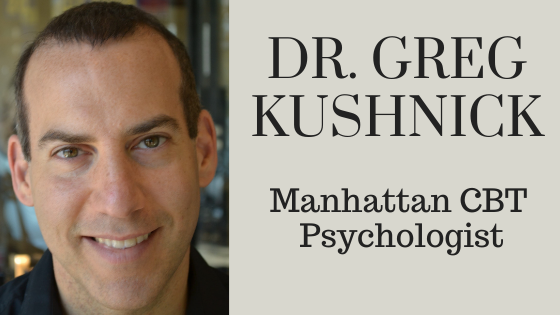
CBT for Social Anxiety in New York City
We all have a need to connect with others. This basic human need can be a source of mental discomfort if we have obstacles preventing us from placing ourselves in opportunities to gain social fulfillment.
Social anxiety is a common experience, but for many New Yorkers, especially people who lean toward a high achievement/high control-type of personality, social anxiousness can reach incredibly uncomfortable levels that promote avoidance of potentially satisfying experiences and relationships. Social anxiety disorder (SAD), also referred to as social phobia, is a label that is given when the anxiety has a debilitating impact on your life. I’m not a huge fan of labels, but sometimes they are helpful for making distinctions and identifying the best course of treatment. Social phobia is sometimes used to refer to unrealistic fears regarding a specific social scenario.
The tricky part of social anxiety is that avoidance often becomes the default way of coping. Of course, mild avoidance of social situations can be helpful, as it allows for time to sit with one’s thoughts and recover from a stressful week or a particularly exhausting experience. However, more persistent avoidance of social situations leads to a vicious cycle of greater avoidance and self-loathing/self-criticism.
When you actively avoid social situations (or use significant amounts of alcohol to cope with social situations), you experience relief from the feared scenario of having to endure extreme discomfort, a panic attack, potential rejection or failure. However, for many people there is also an equally uncomfortable or even worse feeling of discomfort that comes with the failure to socialize.
People often judge themselves harshly and feel remorse about missing an opportunity. Taking away opportunities for social connection only reinforces negative beliefs about the self. In addition, I have found that chronic social avoidance caused by social anxiety also leads to varying amounts of depression, ranging from a mild case of the blues to more severe and debilitating depressive experiences that affect daily life in profound ways.
CBT Therapy for Social Anxiety
The good news is that therapy for social anxiety can be very effective. I find that clients seem to benefit more when I incorporate cognitive behavioral therapy (or CBT therapy for short) tools into my approach. Exposure therapy for social anxiety disorder is added to the treatment as needed.
Put another way, successful treatment of social anxiety via CBT therapy requires a few components:
- A cognitive approach that emphasizes altering thinking errors and unrealistic self-standards, and reduces self-criticism and rumination.
- A behavioral/coaching approach that focuses on reducing unhelpful emotional responses and increasing exposure to social situations, while using feedback gleaned from new social experiences to inform efforts to alter problematic beliefs and standards.
Managing Social Anxiety in NYC
New York City culture amplifies the importance of social success and performance. The most socially successful people are celebrated in real life and on social media, which creates pressure, shame, FOMO, fears of losing one’s job, and a lot of other uncomfortable thoughts for many people.
Frankly, it’s just a whole lot of pressure to be social in NYC.
Since the pandemic ended, I have seen a significant increase in the number of clients requesting CBT therapy for social anxiety/phobia. It seems as though the stakes are even higher in a post-pandemic NYC where many people are working remotely at least part of the workweek, which limits opportunities for true social connection and places people in their own heads for a greater portion of the day, as opposed to directing energy toward others.
This closed system of chewing on your own thoughts in place of in-person social exposure appears to make thoughts of self-doubt, rejection and avoidance run wild.
Effective Social Anxiety Treatment in NYC
I’m here to help you with your social anxiety. If you’re searching for a psychologist for yourself or for a loved one, an experienced CBT therapist can make a huge difference in helping to reduce social anxiety and avoidance.
Feel free to reach out with any questions regarding therapy for social anxiety. I love what I do and I am happy to work with you or your loved one.
All the best,
Greg Kushnick
Learn More