
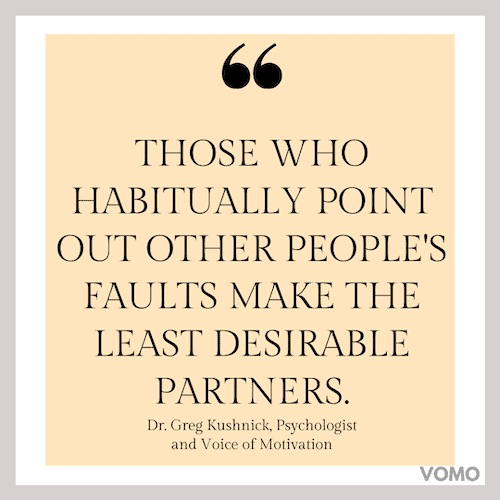
Motivational Quote and Life Lesson on Relationships and Judgmental People
Here’s a short motivational quote and important life lesson when choosing a life partner….
Are you constantly bothered by things people say or do? Do you have a habit of pointing out everyone who you think is wrong or unintelligent? If you think I might be describing you, then this hypersensitivity is ruining your life. You just might not realize it. This motivational lesson and quote about change, unhappiness and judgment is meant to shed light on this common and destructive habit.
The good news is that this type of self-harm is avoidable once you understand the price you pay for your comments and commit to more productive forms of complaining.
The Risks of Chronic Fault-Finding Behaviors
If you constantly point out other people’s problems, you are at serious risk of:
- putting a limit on your happiness
- creating or perpetuating depression
- isolating yourself from your most important relationships
- turning people off from wanting to get close to you
- creating negative energy around you that generates bad luck
- killing the cells in your body with negativity
We all have sensitivities that are specific to our upbringing. It’s all comes down to whether you have a system of monitoring how and when you share what bothers you about people.
All the World Is a Mirror Reflecting Your Pet Peeves Back to You
Your pet peeves color the way you see the world. They are part of the central framework you use to interpret other people’s actions. When you think about the above-mentioned quote about unhappiness and judgment, what does it bring out in you? Do you get reflective or defensive? Is there an immediate denial of a problem or can you stick with it for a moment?
If this bothers you, is it because it’s a problem you grapple with or a habit of someone close to you?
The types of behaviors that get under our skin vary greatly from person to person. Some people can’t help but have a problem with everyone who chews with their mouth open. Other people police the world looking for pedestrians who walk too slowly, or who blast their youtube videos on public transportation.
Some people will see this post as a group of anger management tools. That’s fine…whatever helps you to take my recommendations seriously if you’re the type of person who has an addiction to pointing out other people’s faults.
The challenge I know I’m up against is that people who have a bad habit of judging others tend to be the most defensive people when it comes to recommendations for bettering their life. They tend to dismiss anything that recommends a change in viewpoint. I hope I can get through to those people as well.
Please pay special attention to the last recommendation, as it is by far the most important point.)
Recognizing the THE FAULT FINDING RADAR
The one with the fault finding radar is the unhappy person of the group. I promise you.
Often times, this person has admirable qualities that make others avoid challenging his or her judgments. He or she may be in a position of authority or have a ton of experience to back up his or her beliefs. It doesn’t matter. They are essentially shooting themselves in the foot with this habit.
The fault finding radar compels a person to constantly point out whats wrong with other people. It’s the ultimate recipe for misery.
Now you might be thinking that misery created the radar, as opposed to the reverse, and you’d probably be correct in thinking this.
5 REASONS WHY CONSTANT FAULT FINDING IS MAKING YOU UNHAPPY (AND WHAT TO DO ABOUT IT)
1. Pointing out what bothers you about people only worsens your deep-seated insecurities.
The habit of constantly pointing out people’s faults is most likely a reflection of what you’ve struggle with in childhood. It is a manifestation of an insecurity about the very things that you judge other people for most often. Some people who have difficulty taking responsibility for their own actions have a tendency to project onto others that with which they struggle. In fact, the avoidance of responsibility and a difficulty apologizing to people you’ve hurt are the trademarks of the constant fault finder.
Solution A: There are other ways to conquer your insecurities. Start by pointing out the good in people, including the smallest acts of wit and wisdom.The more you invest in recognizing the greatness in the world, the more this will translate into recognizing your own greatness.
Solution B: Ask someone close to you the following two questions: (1) if you have difficulty apologizing for your actions, and (2) whether you avoid taking responsibility for how your actions affect others.
This insight needs to come from someone else because the self-awareness is often compromised in the chronic fault finder. It’s a costly interpersonal blindspot. Work on taking responsibility for small things. Own your part when misunderstandings arise. See the value in apologizing as a way to clean up a mess.
2. Fault finding in others may be your way of attempting to master memories of an overly punitive parent.
Can you recall a parent or other influential relative who often pointed out everyone else’s problems or faults? I’m guessing that, if the answer is yes, you harbor some form of resentment toward this person, especially if you have memories of him or her being critical of you.
As far as I’m concerned, there’s no better way is there to overcome memories of an overly judgmental parent these recommendations:
Solution A: Move toward forgiveness of people who were overly critical of you in the past. Psychotherapy can help immensely with limiting the negative impact of the past on the present. There is absolutely no gain for you to hold on to resentment. Choosing not to forgive is like choosing sickness for yourself. Forgiveness sets you free. Strive to understand the value of forgiveness. Consider reading Forgivenessby Simon and Simon. It’s a game changer!
Solution B: Try to remember any positive qualities in your punitive relative, even if it’s hard to do. Most importantly, avoid showing the world how you inherited the tendency to judge others. Vow to judge other people less, and challenge your own judgments after you arrive at them. Judging is inevitable. It’s how repulsed you are by your own judgments that matters. See my post on judgment for a concrete technique to limit the negative impact of judgment on the mind and body.
3. Constant fault finding gives you a temporary ego boost and the illusion of superiority in the moment, but crashes your mood a few seconds later.
Not far from the way gossip works, judging another person gives you a rush in the moment, but the rush is soon replaced by unhappiness thereafter.
I love this inspirational quote about gossip by Eleanor Roosevelt (or Socrates depending on the source):
“Strong minds discuss ideas, average minds discuss events, weak minds discuss people.”
Solution A: The goal is to stop yourself from verbalizing your negative opinion even if you have the thought. Create a filter that decides which complaints are necessary and which should be left in your mind. It really does come down to the cliche, “If you don’t have something nice to say, keep it to yourself.”
Solution B: Too much concern with other peoples’ marital issues, bad habits, limitations or weaknesses is a sign that you must invest more in committing to your own personal goals. Try some of the recommendations from one of my favorite posts about committing to your own personal growth.
4. Frequent complaints about what other people say or do promotes depression.
Too much focus on what’s wrong with others can sour your mood in an instant. Depression pulls for either self-devaluation or finding fault with other people or the world as a whole.
Solution: While there are many degrees and manifestations of depression, one strategy for climbing out of the darkness is to practice gratitude. Make a list each morning of 5-10 reasons why you are grateful. Continue every morning with this. If you’re committed to this practice, you’ll see a difference…and you’ll find yourself judging people less, including people you deem to be unintelligent.
You can also practice various forms of gratitude on social media. Take a look at this post highlighting the importance of gratitude. For an interesting challenge, try posting each of these five forms of thankfulness on Facebook.
5. A tendency to point out other people’s faults destroys your curiosity and the cells in your body.
The tendency to see people in black and white terms with no middle ground often predicts excessive judgment of others. You see someone as either fine or scum, smart or stupid, pretty or ugly. This habit promotes a sense of isolation from others, unhappiness, and, most importantly, sickness. I have a theory that when your curiosity is closed down. case, you age faster.
Yes, if you need even more reason to stop pointing out other people’s faults, just know that bitterness kills. It probably promotes cancer and suppresses the immune system.
Solution: Even if you tend to naturally see people in a binary manner (e.g., good/bad or smart/dumb), push yourself to see and accept the many shades of people. One mistake, foolish act or asinine comment does not mean the entire person is unintelligent.
Respect the power of negativity, bitterness, and more specifically, the tendency to find fault in others to make your mind and body turn on itself. Show self-respect by avoiding something that is eating away at you, bit by bit, negative comment by negative comment.
It ultimately comes down to the decision of whether you want to be right or happy. You choose.
If you’re not the fault finding type, but someone close to you is, consider sharing this motivational quote and lesson about judgment with him or her.
A FINAL NOTE
Please note that it is human to find fault with others. There are both healthy and pathological levels of the fault finding habit. It’s actually healthy to sometimes be critical of others. Sharing your opinions, even if they contain venom, can bring psychological relief under certain circumstances and can be experienced as a form of self-expression. Criticism combined with personal accountability is often healthy. Also note that I haven’t talked much about the habit of constantly recognizing your own faults. Some of the solutions I’ve offered do apply to self-judgment, but I will address this at some point in a separate post.
Please feel free to comment below or ask questions about my recommendations.
Learn More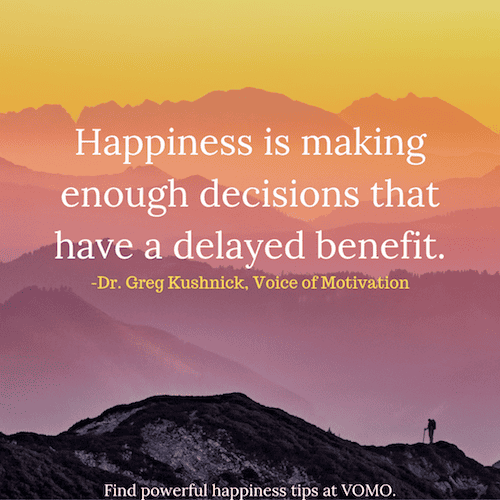
Inspirational Quote and Life Lesson on Happiness and Delaying Gratification
Happiness Quote and Life Lesson
Happiness is a fleeting state, much less enduring than you’ve been led to believe. We are bombarded with media messages that pleasure should be immediate. This happy quote is meant to inspire you to expand the way you think about happiness. (For more on changing habits to increase happiness, please take a look at my Motivational Guide to Happiness.)
The constant experience of instantaneous gratification offered by your phone, your TV, recreational drugs, food, and other sources decreases your chances of actually feeling happiness when the opportunity arises.
You’re so used to the quick hit that your mind is unlearning how to deal with real rewards. In fact, the practice of waiting for a reward is becoming obsolete. People want things now. Period. This phenomenon is contributing to a widespread depression epidemic across technologically advanced cultures.
Yes, of course there are habits of thought and action that promote more positive feeling states. Yes, you can design your life to gain more fulfillment, but I think it’s important to stop thinking about happiness as a stable and enduring trait. It’s just too much pressure. It adds a shaming element when your expectations are not met.
Even if you reached a goal that brought happiness, you would eventually get used to the positive state and require changes to maintain happiness.
In fact, try too hard to find happiness and you will fall right through it.
What Is Happiness? One Helpful Angle.
Think of happiness as a commitment, an agreement to engage in a series of behaviors that promote a fleeting state of positivity that sometimes feels meaningful.
As my happy quote suggests, your happiness can disappear or decrease with one troubling thought. That doesn’t mean that you can’t get it back.
It just means that happiness is a fragile state of mind and your mental health will improve when you’re able to embrace this idea.
How to Prolong Happiness
I can go in many directions here. It comes down to two things:
- Monitor with vigilance your thinking and any changes in your mood.
- Be honest with yourself about what leads to unhappiness.
We all know what unhappiness feels like, but can you catch the thought or action that suddenly alters your mood? It’s hard to do but with practice it can be achieved.
Strive to develop an observing self, a wise part of you that can take evasive action when you’re falling down the rabbit hole. Monitor your thinking in a way that isolates and quarantines unhealthy or negative thoughts.
Be honest with yourself about how you’re likely to feel if you indulge in a negative thought.
The problem is that people lie to themselves about what will make them feel happy and they generally focus on the immediate effects of a behavior. This means being truthful about the medium and long-term consequences of an action. For example, going out an getting drunk may numb your mind for the night, but it’s also associated with a spike in depression and anxiety about a day and a half to two days later. Is it worth it?
If unhappiness is easier to hold on to, make corrections when you know you’re sliding downward.
More Ways to Protect Your Happiness
Judgment promotes unhappiness.
If your next thought is a judgment against yourself or someone else, note to yourself that you just judged. Pay attention to how many times you judge.
Along the same vein, stop making people wrong. Just because you disagree doesn’t mean you’re right and they’re wrong. It’s your opinion. Learn to tolerate other opinions and happiness becomes less elusive.
Stay away from the Land of Good and Bad.
Avoid labelling yourself, your food, your experiences, other people….as good or bad. Food is not good or bad. It’s neutral.
The more you identify and label things as “bad,” the more you will hate yourself. You can label an action as unhealthy or unsatisfying or not ideal, but stay away from the word “bad.”
Limiting your descriptions to good or bad will predict less happiness.
Since you are only as happy as your next thought,
Learn More