
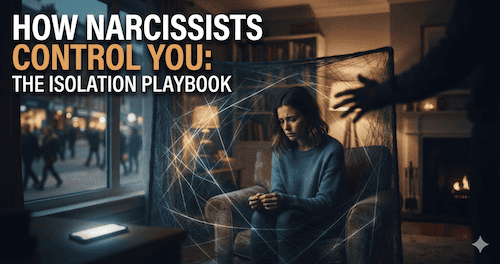
How Narcissists Control You, Part 1: The Isolation Playbook
It didn’t look anything like a narcissistic isolation tactic in the beginning. You caught their subtle eye roll, a look of disapproval, a moment of psychological distance. All you did was get together with a close friend but your partner wasn’t pleased that you received outside support.
After all, this friend has been there for you in tough times. Your narcissistic partner, however, saw this interaction with your loyal friend as a threat. The pattern of narcissistic manipulation is predictable: Over time, subtle disapproval transforms into overt attacks, punishment and judgment when you access your support system. At some point it’s becomes no longer worth it to maintain the same relationship with your support network since you know the price you’ll have to pay. Plus, with enough repetition of the manipulation tactics, you may actually start to believe the terrible things said about important people in your life, and even about yourself. That’s the power of narcissistic abuse.
The hope is that you recognize this narcissistic manipulation tactic early and run for the hills, but that’s not usually how it happens.
Narcissists have one goal: control. They clip your wings by convincing you that you can’t trust your own version of reality, or that a supportive figure in your life has bad intentions or no value. They punish you and shape your behavior to serve their needs, especially when they believe you’ve betrayed them. Over time the partner of a narcissist becomes frozen with confusion and conflicting ideas about people in their inner circle and the validity of their own needs.
Prolonged reliance upon a narcissist for validation and everyday support will lead you to find yourself very alone in the world. Intense loneliness, confusion, fear, shame, self-doubt, and depression can keep you from reaching out to the people who used to be there for you.
The narcissist gets away with terrible behavior by isolating you from outside influences.
You’re officially caught in the loneliness trap. Cut off from great people. Cut off from yourself.
Your only source of social support has manipulated you to only look to them for your emotional needs. The relationship dynamics are designed to keep you off balance as you perpetually question what is real and imagined. As a result, you’re so confused that you won’t act on your desperate longing to be seen, heard, and understood, even though a part of you that knows something is terribly wrong. Your only source of love, connection and value is a person who will never make you feel secure.
The price you’d have to pay for going against the narcissist’s is steep. For relationship survival, it’s often easier to just go along with the narcissist’s wishes and opinions. You know full well that if you choose to seek outside support, you’ll be punished, often through a combination of threats, shaming, and emotional/physical distancing by the narcissist.
I see this pattern of partner isolation in just about every client in my New York City private practice who seeks help for managing the emotional wreckage experienced in their current or former relationship with a narcissist. This painful and effective narcissistic control tactic is not just limited to romantic relationships. It can also occur with a friend, parent, colleague, boss, classmate or anyone with enough time and access to you manipulate your loyalty. New York City, for all of its energy and ambition, is a breeding ground for narcissistic personalities. Plus, the city’s culture of status and achievement draws people with narcissistic tendencies like a magnet.
Why am I writing this article? Because the number one predictor of how long you’ll grapple with the worst psychological consequences of narcissistic abuse is the extent to which you move toward or away from your support system when you’re suffering.
The biggest predictor of the length of your mental anguish in narcissistic abuse is whether you move toward or away from your outside support system when you’re suffering.
I’m going to help you understand the dynamics involved in how the narcissist isolates a partner in a romantic relationship. Among the many strategies for managing narcissistic abuse, (1) arming yourself with psychoeducation about the narcissist’s tactics and (2) learning options for creating more psychological air in your lungs can help you to either survive or leave such a painful relationship. (If you find that I am describing your situation, please seek mental health support to assist you in managing this telltale sign of narcissistic abuse.)
The Narcissist Poisons the Well of Support
The narcissist has a strategy. The goal is to make you question the intentions and loyalty of the people who you’ve relied on for support. When slightly negative comments about your closest friends and confusing observations about your family members begin to plant seeds of doubt and confusion in your mind at the onset of the relationship, you might have the courage and will to challenge the narcissist’s version of reality before their influence over you isn’t fully developed.
However, once their hold on your opinions and choices grows from subtle to overtly antagonistic and brutal, the price you’ll pay for challenging them can become way too steep. Who wants to be mistreated all week for challenging your partner’s negative perception of your sibling? Who wants to be ignored for days for suggesting that you want to take a short trip with your best friend? If your partner is more of a covert narcissist, the guilt that your partner is capable of inducing in you for abandoning them can be stifling. Eventually, it’s likely that you’ll feel like a horrible human being, a disloyal partner for seeking basic support outside of your relationship. Some fragile narcissists even threaten to harm themselves or engage in risky, self-destructive behavior when they feel abandoned. It’s very scary.
Before you know it, you’re questioning the intentions of other people who were there for you in your darkest moments. You don’t fully trust your judgment either, so what can you believe?
When you get a text from a friend: Are you ok? I haven’t heard from you. I’m worried about you. We gotta talk, your narcissistic partner puts you down, diminishes your worth, your power, your judgment. They punish and threaten you. The more covert narcissistic partners have a different approach: they get so fragile, depressed and sad that your guilt and anxiety freezes you up and stops you from responding to a concerned friend’s text. Eventually, even your closest supporters stop reaching out like they used to. They are too frustrated by your cryptic response (or lack thereof), or they are convinced that you no longer value the relationship. Half-intentionally, you taught your supports to stop sharing their concerns about you or your narcissistic partner. Now you’re intensely lonely, except when the narcissist is in the mood to make you feel wanted by them.
The narcissist creates an elaborate, air-tight social seal to make sure you’re no longer relying on the people who love you dearly. Lost are all of your best potential reality checks, the people who root for you, who lift you up when you fall and call you out on the way you might lie to yourself. With no checks and balances on your perceptions that supportive people can offer, the narcissist has full control.
The Narcissist’s Manipulates You Into Conflict with Your Support System
A remarkable ability of the narcissist is the way they can mold your thoughts and behavior to put you in conflict with your most supportive people. Was it your idea to skip the holidays at your parents’ house? Even if it wasn’t, the narcissist can slip thoughts and intentions into your mind to make you fully believe it was your choice. Among the more aggressively subtle and effective tactics of the narcissist is to plant ideas in the minds of others when you’re all in person. They might publicly shame and embarrass you in front of your friends or family to the point where you want to hide. They could get others on their side to make you feel ganged up on. They are capable of making your family members wonder whether you’re the one with the problem. The end result of these social manipulations is distance between you and others. The narcissist is the master of creating a split between you and others, as well as between you and yourself!
They plant ideas in your mind about important people in your life to make you say and do things that lead to fractures in your relationships. The doubts planted in you usually center around loyalty and intentions. To oppose your narcissistic partner’s perceptions is to create your own pain and suffering. Exposure to constant questioning of people’s behavior, motivations and value will shape your mind to take on these beliefs, or at least create enough inner confusion and conflict in you that you spend your energy going to war with yourself. Since narcissistic abuse leads people to doubt their own reality, it makes sense that you would borrow your partner’s view of the world, especially when they speak with such certainty.
If your fragile, narcissistic partner feels threatened by your closeness with your mother or father, they will convince you that your parent believes something negative about you. What’s challenging about this is that sometimes these ideas are partially grounded in the truth, so they are easy to adopt and hard to argue against. The narcissist will point out the one or two data points out of a lifetime of data points that supports their theory.
Manipulating both the supportive person and the victim of narcissistic abuse can be very effective. An example of this would be a narcissist who convinces her boyfriend’s father that his son (her boyfriend) is unreliable, doesn’t take charge, and needs a strong partner to teach him how to handle life like a man. The boyfriend’s father is so impressed by his son’s girlfriend’s wisdom, success and charisma that he begins to question his son’s judgment and starts to see him differently. When the son complains to his dad that he is being mistreated by his girlfriend, his dad doesn’t support him as he should. In addition, the narcissist convinces her boyfriend that his father doesn’t think highly of him, even citing an actual insult that the narcissist manipulated the father into saying. The narcissist also ignores her boyfriend’s complaints that she is meddling in his relationship with his family member.
The Most Confusing Narcissistic Isolation Tactic: The Battle Against Your Own Judgment
The narcissist is the master of making you question people’s loyalty and intentions, which often results in a devastating sense of loneliness, and the way this is maintained is because prolonged exposure to narcissistic manipulation also cuts you off from yourself!
They challenge the things you appreciate about people.
They put you down for taking care of yourself.
They make you question whatever they need you to stop thinking.
They withdraw their love when they believe you went against their wishes.
They put you down until you start behaving in line with the negative beliefs about yourself that they’ve cultivated. Then you do it for yourself even in their absence.
They shape the belief in you that you are undeserving of anything more than they give you.
One by one, their manipulations erode your anchor to the outside world. Maybe you’ve heard them say the following:
Your parents are horrible people. They’re a terrible influence. Why talk to them?
Your sister is only out for herself.
Don’t you see that your friend is using you?
Your best friend is a loser. Why do you hang out with them?
Your friend group adds nothing to your life. Why would you want to talk to them?
I’m a good judge of character and you seem to choose the wrong people.
(If your partner is more fragile and introverted):
How can you make plans with that person when I…told you not to/hate them/don’t trust them.
Why did you leave me alone at home when I needed you?
That friend is trying to steal you away from me.
Your Reluctance to Share with Friends and Family About the Narcissistic Abuse
Once your narcissistic partner’s questions about a supportive person’s intentions and loyalty are planted in you, it tends to become increasingly harder to communicate with the person in question with the same frequency and level of vulnerability. My clients have consistently reported that the process of social isolation was so insidious that they didn’t even notice it happening until the loneliness and desperation was so extreme. It’s as though one day they woke up and realized that this their reality and they can barely believe it. They ask, “How did I get here?”
Let’s briefly break down what might keep you from reaching out to the people who have supported you in the past. First, as we said above, there’s the potential consequences of your partner knowing you sought outside support, but I’ll keep it moving and assume that you’re open to seeking social support either covertly or you’re willing to endure your partner’s reactions.
So what’s left that could stop you from tearing down the wall and moving toward your supports?
People You Abandoned Due to Your Relationship with a Narcissist
You have the issue of what these formerly supportive people might think of you since you “abandoned” them. Will they forgive you? Have they truly written you off?
If there’s one message I want you to get from this article, it’s that someone who has supported you in the past, especially a very close friend or family member, is VERY likely to embrace your efforts to reconnect IF you’re willing to fill them in on the actual events that took place in your abusive relationship so that they understand the extent of how badly you were manipulated and mistreated. Take accountability for your role in decreasing communication where this is appropriate.
If it was the supportive person who clearly pulled away from you over time, then that tends to be a bit more complicated, but you can explain your current intention in reaching out. What if you used to share the details of your abusive relationship with this friend, maybe even too often, and the friend became so tired of your complaints, helplessness, and lack of action that they distanced themself from you? This does happen to some people. A friend with whom you shared too much and too often may not be as warm to the idea of a reunion. It becomes a 50/50 chance of a successful reigniting of the relationship because the relationship was built on unhealthy terms with too much dependency. The odds improve if you can share accountability for your part in overwhelming this friend and state that you want to create a healthier dynamic as long as you mean it.
Most close friends and family will be so happy to hear from you. They will feel devastated for you, and their empathy and perspective will begin to free you, even just a bit, from the bonds that tie you to the unhealthy aspects of the abusive relationship. You will be offered a chance to borrow their light, their hope and their perspective to try on a different view of the relationship. Be prepared though….they may not believe you at first. You will have to explain the dynamics as though you’re educating them on both the subtle and dramatically overt tactics used to control you in narcissistic abuse. In addition, your sense of trust and fear of being hurt or lied to will likely rage as you let yourself be vulnerable. That’s the effect of being gaslighted by the narcissist. The protector part of you could remain overactive, pushing you not to reach out to people. Try to recognize this part of you as having good intentions because you were hurt before and this part doesn’t want you to be hurt again. Let this part be there but assure this part that you’ve got this under control and the benefits of seeking support far outweigh the risks of being hurt by a friend.
If you’re lucky enough to escape the psychological grasp of the narcissist and share what’s going on in your relationship with someone who has high Emotional Intelligence or, even more powerful — someone who has also endured narcissistic abuse — then you will feel something very powerful. Your reality will get a desperately-needed dose of validation.
Shame and Embarrassment About Being Trapped in Narcissistic Abuse
What about the shame and embarrassment about getting into a relationship with a narcissist? So many people say to me, “I thought I was______ (stronger, smarter, more self-aware, etc.) than that to get stuck in such an unhealthy relationship. Others who have endured narcissistic abuse from their parents may be surprised to find themselves reliving terribly painful childhood dynamics in a romantic relationship.
Whether it’s your first exposure to a relationship with a narcissist or you’ve endured it before, the important message here is that just about everyone I know (myself included), has found themselves stuck in a relationship with a narcissist. It’s actually becoming more common due to modern cultural trends. The goal is to avoid making global judgments about yourself about getting yourself into such a painful relationship. Part of taking good care of yourself is allowing for relationship mistakes to be made. It’s all about the recovery process, which includes the planting of new seeds of self-compassion and an openness to seeing things differently than you’ve been trained to think by the narcissist.
Most people who gave you solid support in the past will understand what you’ve been through even if it takes time to explain. Of course, there are people who are in denial about their own mistreatment in the past. If they lack awareness and emotional depth, or avoid vulnerability around their closest friends, they are not the ones you want to seek for support, unless they represent your only option. People who avoid vulnerability tend to fall short in offering the kind of support someone needs during or following a relationship with a narcissist. It often means that they carry their own unacknowledged shame. Sharing your abuse with they might even make you feel like it’s an extension of the gaslighting you endured in your relationship. They might say to you:
“It couldn’t have been that bad.”
“But they’re so successful/charming. They don’t seem like the kind of person who would do this.”
“I just don’t understand. How is that possible?”
“Are you sure you’re not overreacting?”
Vulnerability-avoidant people will feed you this #@*&. They won’t grasp the nuances of narcissistic abuse. Seek out people who’ve shared their own vulnerabilities with you, not those with a tendency to present a polished version of their life as Instagram-perfect. Avoid confiding in people who tend to find fault in others and people who judge others and seem to make a habit out of being right.
When someone can admit their weaknesses, they will disarm your shame because you won’t have to feel perfect around them. You can just be good enough or even highly flawed like everyone else.
I say all of this because some people who are recovering from trauma endured with a narcissist can find themselves seeking support from the wrong people, even people who are narcissists themselves, and then the damage is worsened and recovery stalls. This is further complicated by the fact that many narcissists temporarily become profoundly supportive, almost like no one else, when you’re in a dire state of need. This one-down position feeds their ego, their drive to feel needed. You’re allowing them to save the day when you come to them and give them all the power. But they won’t save you. They won’t validate what you’ve endured because they don’t have that kind of insight. They just want you to need them.
Just to summarize, steer clear of people who are avoidant of being authentic and vulnerable, and know that a tell-tale sign that you will be disappointed with the quality of support you receive following narcissistic abuse is people who have a habit of pointing out other people’s faults.
The Mind-Bending Complexity of Narcissistic Abuse
It is a real skill to understand the dynamics involved in narcissistic mistreatment. Most people struggle to wrap their mind around the nature of narcissistic abuse tactics. The complexity of this dynamic can be just too much to grasp. As a result, it often means that the victim gets blamed.
Even some therapists have a hard time supporting their clients through narcissistic abuse. Even with the best intentions, they might blame the victim. I can’t tell you how many times clients have told that their last therapist didn’t believe them when they shared the details of the abuse. A mental health professional might make dangerous recommendations if they don’t understand the nature of what narcissists do. People who have endured narcissistic abuse tend to be especially sensitive to others who don’t believe them because they’ve already suffered so much as a result of a narcissist chronically denying their experience.
Be prepared for this from your support system, as it can contribute to feeling even more lonely and misunderstood when someone you confide in can’t easily validate your experience. Be patient with explaining what you’ve been through. If you reach out to someone and they struggle to support you in the way you need to be treated, consider saying something to them. Tell them what you need from them. Do you want them to stay quiet and just listen? Ask more questions? Do their own research on narcissistic abuse?
You can also ask them to watch a show that contains aspects of narcissistic abuse. Some examples are Sleeping with the Enemy, The Maid, Enough, Gaslight, Black Swan, and The Devil Wears Prada.
Another potentially way to enlighten a well-intentioned, supportive person is to show content from Dr. Ramani Durvasula, a leading expert in narcissism and understanding narcissistic abuse. Here’s a video she made that can be helpful in understanding narcissistic abuse. Her information is incredible!
If they have a history of loyalty and solid support, try to explain to them a few times. If they seem to make you feel blamed, please don’t stay silent, unless it’s clear you need to confide in someone else.
Independent First Steps Toward Dismantling Social Barriers
From my perspective as a psychologist who does deep work with current and former partners and relatives of narcissists, what really matters is (1) that you strive to form a version of reality that is decreasingly influenced by the narcissist, and (2) you begin to dismantle the psychological barriers keeping you isolated from your support network.
Educating yourself on the tactics used by narcissists can be extremely helpful, as the ability to label certain behaviors can assist you with separating your partner’s view of you from a healthier version of reality. Strive to be able to identify the specific tactics used by your partner around keeping you from gaining outside support, but most of all, it’s essential that you can cultivate self-compassion to enhance your right to live a life containing strong social support. Any shame and embarrassment you feel that keeps you from reaching out to people needs to be dealt with, potentially through a combination of therapy and acts of self-love. Facing the truth about your relationship can be quite difficult. Imagining other people’s reactions to what you’ve endured might initially feel too risky, but once you’re able to get some validation, it starts to change the game. Also, putting your loneliness/isolation/mental pain into words (and through art/creativity/other forms of self-expression) is a necessary step toward healing from abuse.
If you’re still in the relationship with the narcissist (e.g., you share children and don’t want to get divorced), you need a strategy to access outside support. For the sake of simplicity, there are two approaches: be open with your partner about your contact with your outside supports and deal with the consequences of this choice, or seek support without sharing all of the details with your abusive partner. In the case of severe abuse, there are many reasons why your partner shouldn’t know about your discussions with outside people until you have a real plan for protection from harm.
Try reaching out first to your least judgmental friend or family member, even if you’ve distanced yourself from them and there’s weirdness in the relationship.
Questions for a Better Understanding the Isolation Inherent in Narcissistic Abuse
In your process of self-discovery, asking the right questions to emotionally separate from the abuse is essential.
Ask yourself:
When did I start to question the intentions and loyalty of my greatest supports?
What do I currently believe about the loyalty or intentions of my formerly supportive ______ (friend, family member, colleague, etc.)? What did I used to believe about this person that was more generous and positive?
What does the narcissist believe about each supportive person who used to be more involved in my life? And what have they actually gained by me honoring their negative perceptions of each person?
Which relationships do I want to rekindle that made me feel loved and supported?
Is there one relationship I can (even secretly) re-establish so that I can get much needed support during this challenging time?
Who is the least judgmental of my estranged friends and family members who would understand why I didn’t keep maintaining the relationship?
Can I explain in a few sentences what happened in my relationship that led to the estrangement? Can I briefly describe narcissistic abuse to someone who might not initially understand the dynamics?
Why is it so hard to imagine that people won’t forgive me for distancing myself from them if I’m willing to tell the truth about the narcissistic abuse?
What has the narcissist in my life done to promote distance from my supports? Explicitly? Implicitly?
Who is the narcissist most threatened by?
Are the narcissist’a reactions to my efforts to steal support from others something I can strive to tolerate better (assuming there’s still contact with the narcissist) or is this an intolerable situation that has to come to a close?
What do I disagree with the narcissist about certain people in my life?
I recommend that, if possible, you also review these questions with a trusted friend who knows you well.
NOTE: Please seek professional care if you believe you are being mistreated by someone with narcissistic tendencies. Help is available.
I wish you all the best in your recovery!
___
Dr. Greg Kushnick is a licensed psychologist serving New York and New Jersey. His offices are located in Chelsea/Flatiron and Wall St./Financial District of New York City. Dr. Kushnick offers concrete tools and practical cognitive behavioral therapy (CBT) techniques. In-person and online appointments are available during morning, afternoon and evening hours. To schedule a complimentary 15-minute phone consultation, email [email protected].
Related Posts

10 Important Benefits of Cognitive Behavioral Therapy for New Yorkers
Living in New York City can be a challenging experience if you're not invested in...

How to Center Yourself in the Age of Anxiety: Values 101
Many people struggle with persistent worry, troubling thoughts and a sense of...